
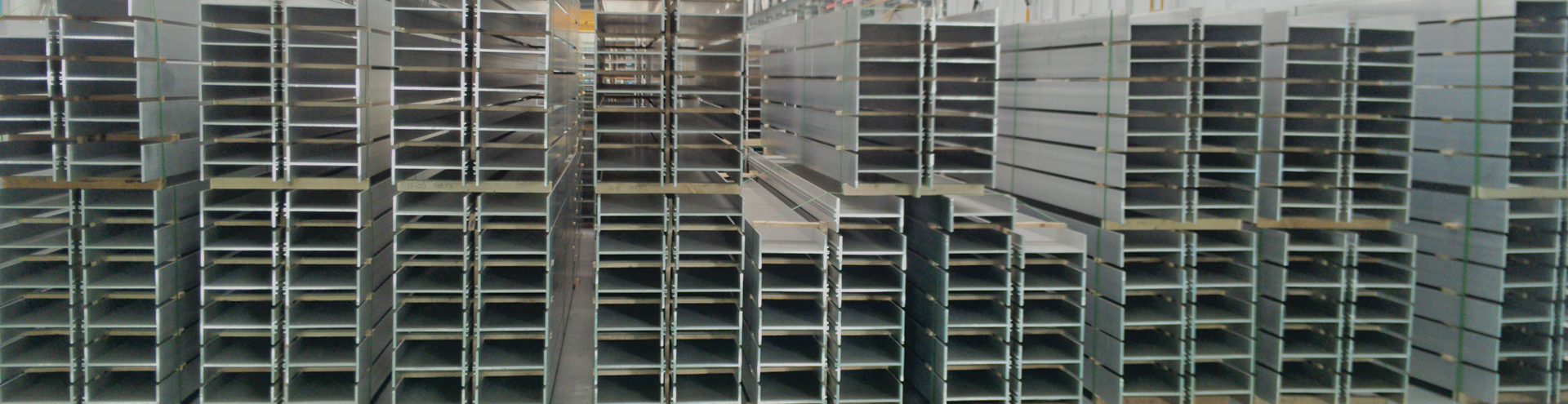
Profiles can be designed for easy fastening and assembly
Extruded features such as lap joints, dovetails, and screw ports provide excellent ways to connect to other profiles or components. As part of the cross-sectional design, these features can reduce manufacturing steps, waste, and material costs.
Profiles are easy to join
Welding, soldering, brazing, adhesives, and mechanical fastening can all be used to join aluminum profiles to other aluminum parts or to different materials.
Profiles can reduce manufacturing steps
Because aluminum profiles are near-net-shape, and holes, slots, or screw bosses can be integrated into the design, secondary processing can be minimized. Profiles can still be further processed through cutting, drilling, punching, machining, and bending. Machining chips are recyclable, further improving cost efficiency.
Aluminum can be extruded to tight tolerances
Every process has deviations from nominal dimensions. For casting, deviations include shrinkage and draft angles. In aluminum extrusion, tolerances are more evolutionary than fixed. Improvements in die design and extrusion practices can result in tighter tolerances than standard specifications. For many applications, extrusion tolerances are more precise than most competing processes.
Aluminum profiles are cost-effective
Extrusion die costs are typically in the hundreds of dollars, significantly lower than many other material processes.
The cost savings go beyond initial tooling. The near-net-shape capability, tight tolerances, and ease of processing and finishing make aluminum extrusion a cost-effective method for producing parts to precise standards.
Lead time (in weeks)
From prototyping to full-scale production, few processes allow designers to obtain production tooling as quickly as extrusion. Dies can often be completed in one to two weeks, while other processes—such as roll forming, injection molding, and die casting—may take up to 20 weeks. Only machined parts may have comparable turnaround times.
Sustainability
Although primary aluminum production is energy-intensive, aluminum’s recyclability—combined with its inherent properties—makes it a key material for sustainability.
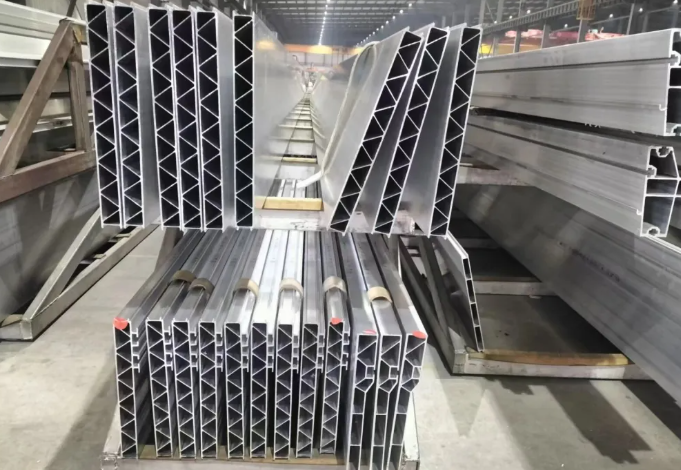
Aluminum’s fundamental properties do not degrade during recycling. It can be reused repeatedly without loss of performance. Producing aluminum from recycled material requires only about 8% of the energy needed for primary production. Recycling one ton of aluminum instead of producing it from ore saves:
·Equivalent of 24 barrels of oil
·Over 15 tons of fresh or seawater
·Over 9 tons of CO₂ equivalent
Its infinite recyclability, combined with light weight, high strength-to-weight ratio, corrosion resistance, and formability, makes aluminum extrusion a critical component in sustainable solutions. Whether by helping reduce vehicle weight to improve fuel efficiency and lower emissions, decreasing energy demand in commercial buildings, or facilitating the installation of solar power systems, aluminum profiles both enhance sustainability and embody sustainable practices.
Recycling: Reality, Not Just Theory
Many materials claim recyclability, but aluminum extrusion recycling is widely practiced:
·For over 15 years, more than half of aluminum production in the U.S. has come from recycled sources
·Nearly all beverage cans and castings are made from recycled metal
·In 2015, about 55% of aluminum extrusions in North America were made from recycled aluminum
·Some manufacturers use significantly higher recycled content than the industry average
·About 95% of aluminum from demolished commercial buildings is recycled
·Over 90% of aluminum from scrapped vehicles is recovered
·Companies like Ford use closed-loop recycling systems; recycled aluminum can produce tens of thousands of vehicle bodies monthly
A well-developed infrastructure for aluminum recycling exists across North America.
Recycled aluminum can meet even the most demanding extrusion requirements, but the process involves careful alloy sorting, testing, and controlled composition—not simply melting mixed scrap.
Environmental Footprint of Extrusion
The extrusion process itself has relatively low environmental impact. The largest factor is the source and composition of the aluminum billet.
Surface treatments such as painting or anodizing add only minor environmental impact. Thermal break systems slightly increase footprint but are offset by significant energy savings in buildings.
Automotive Applications
Weight reduction in vehicles is increasingly achieved using aluminum extrusions. The body of the Tesla Model S is about 205 pounds lighter than competitors, the Audi A8 body is over 225 pounds lighter.
These weight reduction measures improve fuel efficiency and reduce carbon emissions, and for zero-emission electric vehicles, they result in longer driving range and better performance. Therefore, the use of aluminum extrusions in light vehicles is expected to continue growing, with the amount used per vehicle projected to increase by another 50% by 2025. In addition, as manufacturers of heavy-duty vehicles strive to improve efficiency and reduce emissions, the use of extrusions in these markets is also increasing rapidly.
Aluminum usage in vehicles is expected to continue rising, contributing significantly to efficiency targets such as 54.5 mpg standards.
Building Applications
Aluminum extrusions help reduce up to 44% of energy used for heating, cooling, and lighting in commercial buildings. Applications include:
·Light shelves that reflect daylight indoors
·Sunshades that reduce solar heat gain
·Window frames that support larger glass panels for better natural lighting
To address aluminum’s thermal conductivity, thermal breaks (polymer barriers) are used to reduce heat transfer.
Switching to thermally broken frames can significantly improve insulation performance and reduce energy consumption. Since their introduction in the 1970s, thermal break and glazing technologies have reduced heat transfer (U-values) by about 75%.
Reducing Environmental Impact
The aluminum industry continues to improve sustainability: From 2010 to 2015, electricity use per ton of bauxite decreased by about 15%, waste from bauxite processing is increasingly reused in applications such as cement production.
Post time: Mar-20-2026


